

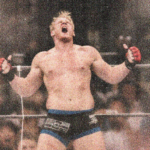


For Elias Theodorou, the hardest weeks of training were also the weeks when managing his pain became more complicated. He lived with bilateral neuropathic pain and said medical cannabis helped him train. But preparing for a fight meant worrying about whether that treatment could lead to an anti-doping violation.
When he spoke with The Scrap in 2019, ahead of his fight against Derek Brunson in Ottawa, he wanted the sport to recognize the problem that created for athletes like him.
Theodorou died on September 11, 2022, at 34. Before his death, he secured medical cannabis exemptions in Canada and the United States. In that 2019 conversation, he was still fighting to have the treatment he relied on recognized by the sport.
The Pain Behind His Advocacy
Theodorou described pain that affected the parts of his body he depended on to compete.
“It basically means nerve damage to my upper extremities, my elbows, my wrist, and my shoulders are in constant pain.”
“It’s through medical cannabis that I’m able to medicate and actually treat it,” he told The Scrap.
His concern was how to continue that treatment through a demanding training camp. Under the UFC’s anti-doping rules at the time, cannabis was prohibited in competition. Using it outside that period did not necessarily eliminate the risk of an in-competition positive test.
For Theodorou, that uncertainty was especially difficult during the final month of camp, when his body hurt most.


“What I’m mostly arguing is that it’s kind of backwards, that’s the hardest part of a fight.”
“The last month is when my body is sore and tired from going through a full training camp.”
He wanted to manage his condition through those weeks without arriving at the fight impaired.
“I will not be under the influence in any way shape or form the day of, I’m looking to get through the training,” he said.
Why He Called It Medical Equality
Theodorou believed the stigma around cannabis made it harder for people to understand his use of it as medication. He wanted the discussion to account for his condition, his treatment, and the demands of his profession.
He recognized something familiar in the resistance. MMA had also struggled for acceptance, and he saw a parallel in the assumptions people brought to cannabis.
“This is almost the same stigma I noticed with MMA, it’s something I see parallels with.”
In Canada, the legal landscape was changing. The country legalized nonmedical cannabis on October 17, 2018, although its formal medical-access framework dated back to 2001. Theodorou felt a responsibility to speak openly.
“I almost felt obligated to come out of the shadows of prohibition,” he said.
His criticism of anti-doping policy came alongside support for its purpose. He wanted opponents held to standards that protected clean competition, and he welcomed the UFC’s partnership with USADA.
“I’m a huge believer in everything USADA does.”
“When USADA and UFC partnered together it was actually one of the happiest days I’ve had as a UFC athlete.”
He believed in the system’s responsibility to protect fighters. He also believed it needed to better account for an athlete whose prescribed treatment involved cannabis.
“It’s not looked at as medicine, all I’m looking for is medical equality.”
The Exemption He Fought to Secure
The breakthrough came after his UFC career ended.
In February 2020, his management announced that the British Columbia Athletic Commission had granted him a therapeutic use exemption for medical cannabis. MMA Fighting reported it as the first such exemption for an MMA fighter.
The approval allowed him to continue his doctor-prescribed use and protected him from a penalty for exceeding the previous in-competition threshold, subject to the commission’s guidelines for medical use during fight week.
He continued pursuing that recognition elsewhere. In May 2021, an announcement issued on his behalf confirmed an exemption in Colorado. The announcement also noted that he had already competed and won against Matt Dwyer in British Columbia that March while using cannabis to manage his condition in the lead-up.
These were individual approvals in specific jurisdictions. They did not automatically change the rules for every fighter, but they demonstrated that an athletic commission could assess his case and accommodate his prescribed treatment.
What His Fight Left Behind
The sport’s approach to cannabis also changed beyond Theodorou’s exemptions.
In 2021, the UFC and USADA changed their policy so that a positive THC test alone would no longer establish a violation. Additional evidence of use for performance-enhancing purposes was required. Athletic commissions retained their own rules.
When the UFC announced its replacement anti-doping program in December 2023, it specified that marijuana had been removed from the prohibited list.
Theodorou’s exemptions allowed him to do what he had been asking for in 2019: treat his pain during training and compete with that treatment recognized by the commission.
“It’s not looked at as medicine, all I’m looking for is medical equality.”