






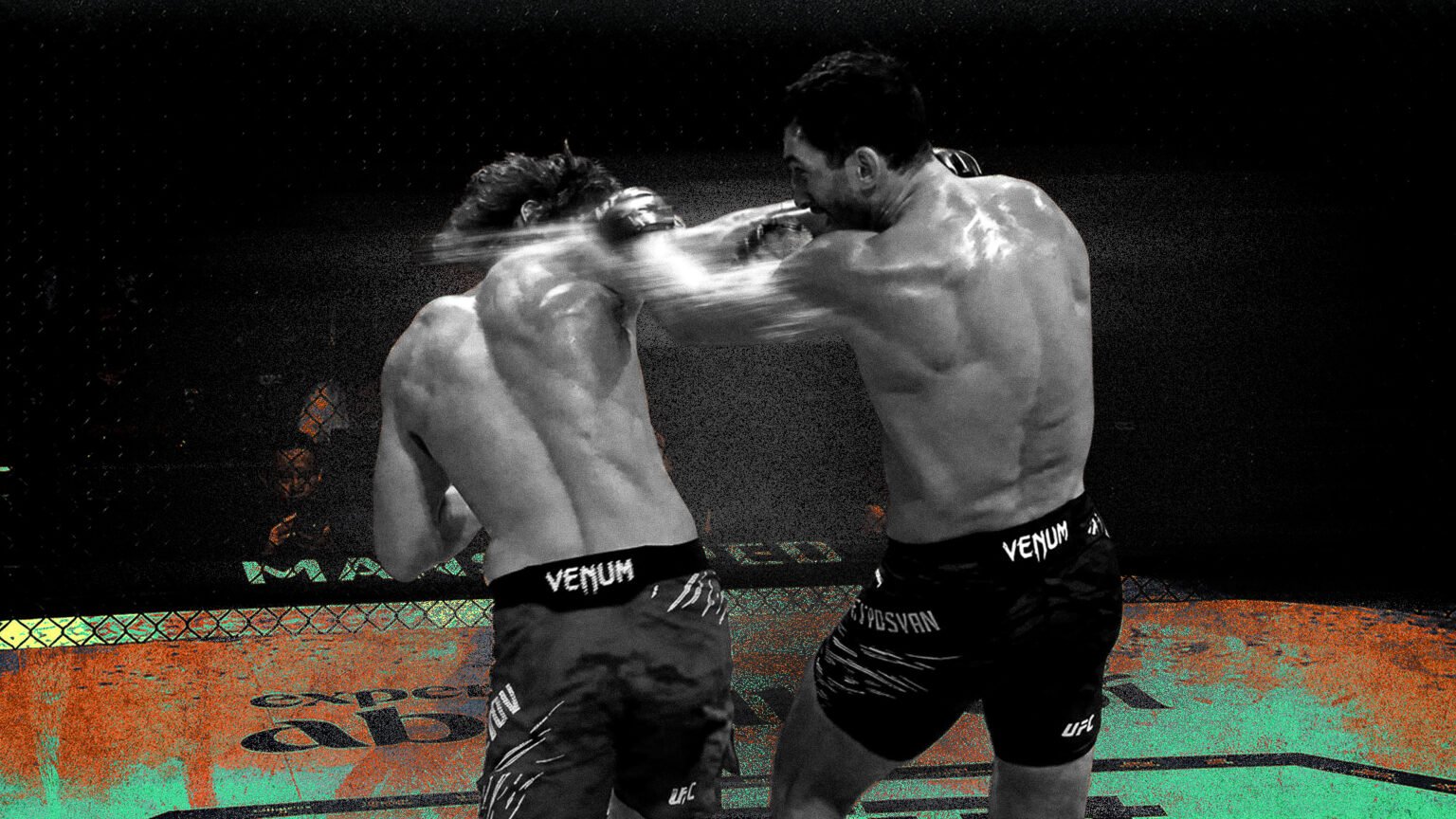

The spinning backfist in MMA is one of the sport’s most unpredictable attacks. It can produce a sudden knockout, disrupt an opponent’s rhythm or create an opening for the next strike. It can also leave the fighter throwing it off balance with their back exposed.
That risk is part of what makes the technique so fascinating. A spinning backfist is rarely the safest option available. However, when it is thrown at the correct range and hidden behind another threat, it can be remarkably effective.
The strike has produced finishes at every level of the sport. Beneil Dariush, Paul Felder and Shonie Carter delivered memorable examples years ago. More recently, Shara Magomedov, Christian Leroy Duncan and Kevin Vallejos have shown how the technique continues to evolve.
The spinning backfist is not merely a wild attack. Its effectiveness depends on timing, positioning and the fighter’s ability to make an opponent expect something else.
How the Spinning Backfist Works
A traditional backfist travels toward the target with the back of the hand. The spinning version adds rotation from the feet, hips and torso before the strike reaches its target.
That rotation can generate considerable force, but power alone does not make the technique effective. The fighter must pivot without losing balance, judge the distance and return to a defensible position. Spinning too early can make the attack obvious. Spinning from too far away can leave it short. Starting too close may prevent the striker from extending the arm or rotating cleanly.
The ideal range is often just outside normal punching distance. From there, the rotation helps close space while changing the angle of attack. The opponent may also mistake the opening movement for a spinning kick, especially when the fighter has already established kicks to the body or legs.
Alexander Shlemenko demonstrated that against Melvin Manhoef in 2015. Shlemenko had repeatedly used spinning attacks before closing the distance with a spinning backfist. Manhoef appeared to react to the possibility of another kick and moved directly into the strike.



The result was later overturned after Shlemenko failed a postfight drug test. Although the official outcome changed, the sequence still shows how repeated spinning attacks can disguise the backfist.
Hiding the Rotation
The spinning backfist becomes far less effective when an opponent sees it coming. Successful attempts are often hidden behind a jab, feint, kick or missed strike.
Beneil Dariush used a throwaway jab before knocking out Scott Holtzman in 2020. The jab was not intended to cause damage. It occupied Holtzman’s attention and encouraged a response while Dariush stepped forward and began rotating.
Dariush also moved away from Holtzman’s most direct counter as he spun. His positioning allowed the backfist to reach the target while his back and shoulder helped shield him from the return right hand. The combination of disguise, distance and direction made the strike far safer than an isolated spin.
Shonie Carter produced a different type of setup against Matt Serra in 2001. Carter narrowly missed a head kick and continued the motion into a spinning backfist. Serra moved forward to counter the missed kick, only to collide with the follow-up strike.
The backfist worked because Carter attacked on the half beat. Serra believed the exchange had ended and began his response before Carter had completed the sequence.
This is one of the strike’s greatest advantages. A spin can connect while the opponent is transitioning between defense and offense. The opening may last less than a second, but that can be enough.
The Double Backfist Changed the Conversation
Shara Magomedov delivered one of the most creative spinning finishes in UFC history against Armen Petrosyan at UFC 308 in 2024.
With seconds remaining in the second round, Magomedov threw a spinning backfist and immediately continued into another from the opposite side. The first attack forced Petrosyan to react. The second reached him before he could reset, ending the fight at 4 minutes and 52 seconds.
The sequence challenged the assumption that a fighter must completely reset after spinning. Magomedov used his first rotation to begin the next attack. Instead of returning to a conventional stance, he continued moving and struck from an angle Petrosyan had little time to process.
It was spectacular, but it was not random. Magomedov recognized that Petrosyan remained within range after defending the first attempt. The second backfist punished that moment of hesitation.
The finish also showed why unconventional strikes remain valuable in MMA. Fighters spend years learning the common patterns created by jabs, crosses, hooks and kicks. Far fewer regularly encounter consecutive spinning backfists from opposite sides.
The Backfist Does Not Need to End the Fight
A spinning backfist can be effective even when it is not officially the finishing strike.
Christian Leroy Duncan showed this against Marco Tulio in 2025. Duncan used a spinning backfist in the second round to badly hurt Tulio, then ended the fight with a right hand. The backfist created the opening and the conventional punch completed the job.
Kevin Vallejos provided another example against Giga Chikadze later that year. Chikadze entered the matchup with extensive high-level striking experience and had never been knocked out in professional MMA. Vallejos still found an opening for the spinning backfist in the second round.
The strike dropped Chikadze and Vallejos followed with elbows on the ground to secure the stoppage. It did not need to render Chikadze unconscious on contact. It changed the position of the fight so dramatically that the finish followed moments later.
These examples offer a better way to judge the technique. Its success should not be measured only by clean knockouts. A backfist can force an opponent backward, break their stance, cause a knockdown or create a second attack.
Using the Spinning Backfist as a Counter
The technique becomes even more dangerous when used against an opponent who is already moving forward.
Paul Felder countered Danny Castillo with a spinning backfist in 2015. Felder had done much of his earlier work from range, which encouraged Castillo to close distance more aggressively. When Castillo stepped forward with a lead hook, Felder rotated into the opening and caught him cleanly.
Felder did not abandon his defense during the spin. He kept his other hand high and lifted his leg as Castillo attacked. Those details reduced the danger of the counter and allowed Felder to rotate without becoming completely defenseless.
Valentina Shevchenko used a similar idea against Holly Holm in 2016. After leaning away from Holm’s left hand, Shevchenko immediately spun with a backfist as Holm attempted to recover her stance. Holm blocked the return, but the sequence demonstrated how quickly the technique can reverse an exchange.
Perhaps the most dramatic example came when Steven Peterson faced Martin Bravo in 2019. Bravo attempted a spinning backfist of his own. Peterson read the rotation and answered with another spinning backfist, knocking him out.
Bravo’s attack traveled low and left his head exposed. Peterson remained close enough to respond before Bravo could regain his stance. It was a rare spinning counter to a spinning attack and a reminder that poor execution can create the exact opening a fighter hoped to exploit.
Why the Spinning Backfist Fails
The same rotation that creates power also creates most of the technique’s weaknesses.
For part of the movement, the fighter may lose sight of the opponent. The back can become exposed and the feet may cross or leave the fighter out of stance. A missed attempt can give an opponent time to punch, kick, clinch or change levels for a takedown.
The strike also becomes predictable when a fighter spins without first establishing another threat. An opponent who recognizes the turn can move out of range, step inside the attack or follow the rotation toward the exposed side.
Distance creates another problem. A fighter who begins too far away may land with the forearm or miss entirely. A fighter who begins too close may collide awkwardly without generating meaningful force. Even a well-timed attempt can fail if the opponent changes levels or exits at an unexpected angle.
Because opponents may duck or turn as the strike arrives, a poorly controlled backfist can also land on the back of the head, which is an illegal target.
There is also a difference between controlled unpredictability and desperation. Throwing the strike simply because a fighter needs a dramatic moment is rarely enough. Most of its famous successes came from an earlier read, established pattern or immediate reaction.
The Advantages & Disadvantages
The spinning backfist offers several clear advantages.
- Rotation can generate fight-changing power.
- The strike arrives from an unusual angle.
- It can disguise itself as a kick or follow another spinning attack.
- It can punish an opponent who rushes forward carelessly.
- It can create a knockdown or follow-up opportunity without landing a clean knockout.
The disadvantages are just as important.
- The fighter briefly turns away from the opponent.
- A wide rotation can be easy to read.
- Missing may leave the fighter off balance and out of stance.
- Poor distance can remove much of the strike’s power.
- The opponent may counter with punches, a clinch or a takedown.
Is the Spinning Backfist Worth the Risk?
The spinning backfist is effective in MMA, but only under the right conditions. It works best as an extension of a fighter’s offense rather than a substitute for it.
Dariush hid it behind a jab. Carter continued the motion of a missed kick. Felder used it against forward pressure. Magomedov turned one spinning attack into another. Duncan and Vallejos used it to create the finishing sequence.
Each example looks unpredictable in real time, yet the best attempts share the same qualities. The fighter controls the range, gives the opponent something else to consider and strikes before the opening disappears.
That is what separates a calculated spinning backfist from a hopeful one. The technique will always carry danger for the person throwing it. In the right moment, it can be even more dangerous for the person standing across from them.