


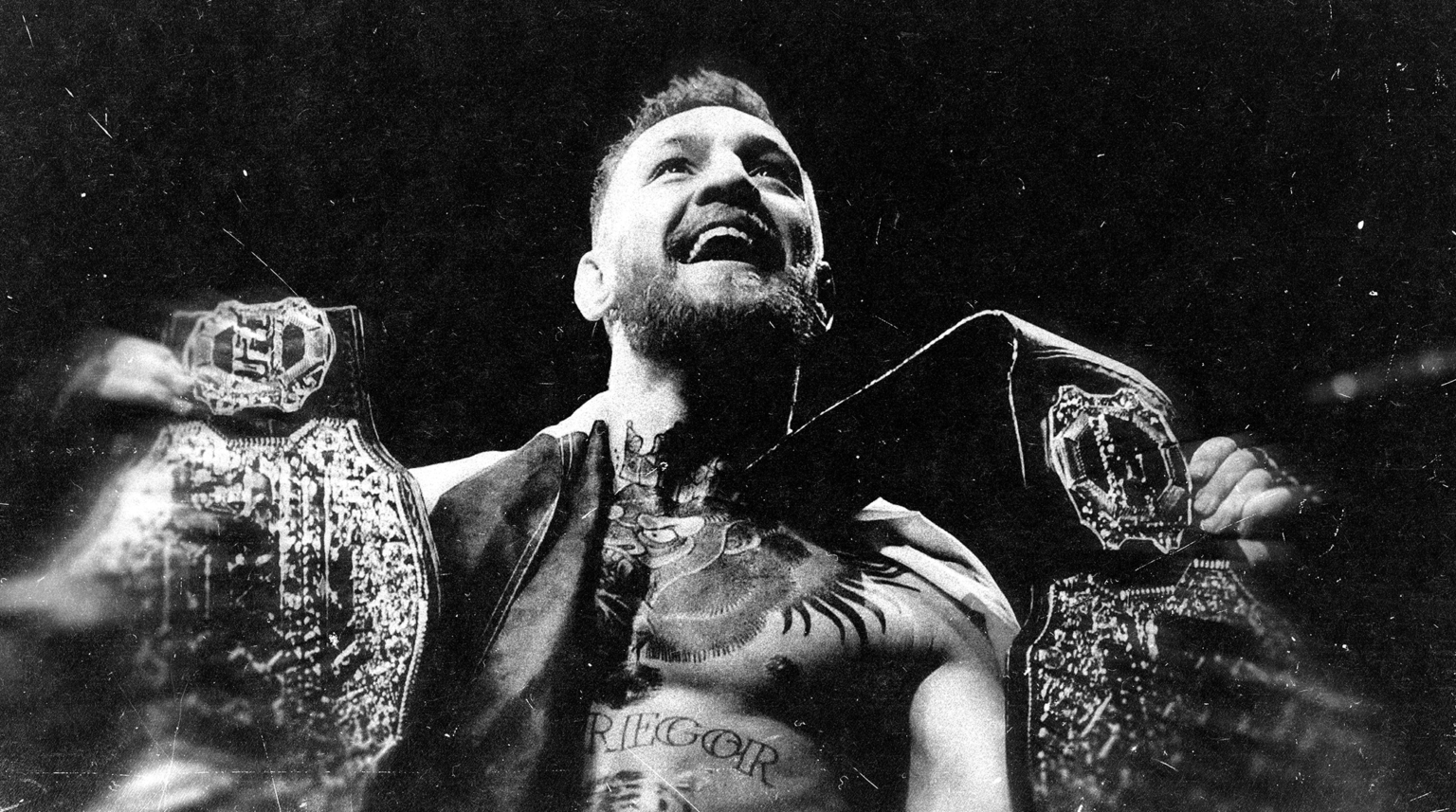

Conor McGregor arrived in a UFC that earlier generations had already helped establish. The promotion had recognizable champions, international audiences, and a place on mainstream television. He entered with ambitions that stretched beyond winning a belt.
His rise changed the scale of what a UFC star could become. Fights became the culmination of months of predictions, confrontations, and spectacle. Press conferences attracted attention of their own. Fans traveled to watch him win, while others paid hoping to see someone silence him.
The performances made that attention sustainable. McGregor’s climb from prospect to champion gave credibility to his claims, and his biggest nights helped push the UFC into a different commercial league.
A Prospect Who Already Thought Like a Star
Before reaching the UFC, McGregor had established himself in Cage Warriors, winning its featherweight and lightweight championships. His ambition to succeed across divisions was already part of his identity.
He made his UFC debut on April 6, 2013, stopping Marcus Brimage in the first round. His post-fight demand for a bonus became almost as memorable as the finish. From his first appearance, McGregor understood that the microphone offered another opportunity to make himself valuable.
There was substance behind the presentation. His distance management, timing, and left hand made him a dangerous striker. He could pressure opponents toward the fence, draw a reaction, and punish the opening before they recovered.
The confidence gave viewers something to remember. The fighting gave them a reason to believe.
That combination made his progress feel bigger than a prospect working through the rankings. Every victory supported the next prediction, and every prediction raised expectations for the next performance.
Ireland Makes Itself Heard
McGregor did not introduce Ireland to MMA. The UFC had visited Dublin in 2009, and the country already had fighters, coaches, gyms, and committed supporters.
His emergence gave that existing community a figure around whom its enthusiasm could become impossible to miss.
In July 2014, McGregor headlined the UFC’s return to Dublin against Diego Brandao. The event sold out rapidly, and his first-round stoppage capped a successful night for the local contingent. His declaration afterward captured the mood.
“We’re not here to take part; we’re here to take over.”
Conor McGregor during his post-fight Octagon interview at UFC Fight Night 46
The atmosphere became part of his appeal. The flags, singing, and crowd reactions made his appearances feel like occasions before the fight began. For viewers watching from elsewhere, that support reinforced the sense that something significant was happening.
As his ambitions moved toward Las Vegas and championship fights, Irish identity remained central to the presentation. He gave supporters someone to follow on the biggest stage, while the intensity of that following helped the UFC sell the experience to everyone else.
His contribution extended beyond attracting fans from one country. He made their support part of the spectacle.
Thirteen Seconds That Validated the Hype
McGregor’s pursuit of José Aldo showed how much attention could be generated before two fighters entered the cage.
Their promotional world tour gave the rivalry months of exposure. Aldo represented established excellence, but McGregor challenged both his championship and the assumption that the challenger had not earned the right to speak so confidently.
When Aldo withdrew from UFC 189 through injury, McGregor faced Chad Mendes instead. He survived difficult grappling exchanges and stopped Mendes in the second round to win the interim featherweight championship.
The victory kept the Aldo fight alive with even greater stakes.
At UFC 194 in December 2015, McGregor knocked Aldo out in 13 seconds, ending the Brazilian’s decade-long unbeaten run. Months of promotion culminated in a finish so sudden that the replay became essential viewing.
Its importance went beyond the belt. McGregor had made enormous claims about an exceptional champion, then delivered a result that exceeded even the expectations created by his own promotion.
The UFC now had a star whose most audacious predictions could not simply be dismissed. That made the next claim, opponent, and event easier to sell.
A Rivalry Bigger Than a Championship
The Nate Diaz fights demonstrated that McGregor’s drawing power could survive a defeat and operate independently of a title.
Their first meeting came at UFC 196 in March 2016. Diaz stepped in after Rafael dos Anjos withdrew, and the fight took place at welterweight. Diaz weathered McGregor’s early offense before submitting him in the second round.
The loss punctured the image of an unstoppable rise, but it created another compelling story. McGregor wanted to prove he could solve the opponent who had beaten him, while Diaz had the result and personality to challenge his command of the spotlight.
At UFC 202, McGregor won their five-round rematch by majority decision. The bout supplied a different kind of validation from the Aldo knockout, requiring adjustments, endurance, and a response when Diaz threatened to take over.
The event reportedly generated approximately 1.65 million pay-per-view buys, establishing a UFC record at the time. No championship was on the line in the main event.
That distinction mattered. The rivalry itself had become valuable enough to carry a landmark event. McGregor and Diaz gave audiences a reason to invest that extended beyond finding out who held a belt.
Two Belts on the Biggest Stage
McGregor’s next major achievement combined sporting history with a significant moment for the promotion.
At UFC 205 in November 2016, the UFC made its Madison Square Garden debut. McGregor headlined against lightweight champion Eddie Alvarez and stopped him in the second round, becoming the first fighter to hold UFC championships in two weight classes simultaneously.
The performance matched the occasion. McGregor repeatedly found Alvarez with precise counters, turning a matchup against an accomplished champion into one of his most convincing victories.
The image afterward, with a championship belt on each shoulder, became a lasting expression of his ambitions. He had talked about taking over, then produced a result the UFC had never seen.
It also gave the promotion a powerful selling point for future champions seeking success across divisions. Holding two belts at once was now an achievement fans could picture, debate, and demand from other stars.
Taking UFC Stardom Beyond the Octagon
In 2017, McGregor crossed into boxing to face Floyd Mayweather.
The contest drew attention from audiences far beyond MMA, with Showtime reporting 4.3 million pay-per-view purchases in North America. McGregor lost by tenth-round stoppage, but the event demonstrated the commercial reach of the name he had built in the UFC.
A UFC champion was participating in one of combat sports’ largest commercial attractions despite having no previous professional boxing record. His MMA accomplishments made the challenge marketable, while his personality helped turn an unlikely matchup into an event people wanted to discuss, debate, and watch.
His return against Khabib Nurmagomedov at UFC 229 in 2018 produced another milestone. The event generated an estimated 2.4 million pay-per-view buys, surpassing the record established by the Diaz rematch. Nurmagomedov won by fourth-round submission, but the business demonstrated how much interest McGregor could bring back to the Octagon.
That audience also became the foundation for ventures beyond fighting. McGregor helped build Proper No. Twelve into a prominent whiskey brand, with Proximo Spirits acquiring a majority stake in 2021 through a deal reportedly worth up to $600 million. That figure covered the broader transaction involving his partners, rather than a personal payout to McGregor alone.
The significance was larger than the sale price. McGregor showed how the attention earned through fighting could support a business that reached consumers independently of his next bout. His name could help sell a product as well as a pay-per-view.
Hollywood offered another extension. In 2024, he made his acting debut as Knox opposite Jake Gyllenhaal in Road House, placing the persona audiences knew from combat sports into a major action film. That same year, McGregor and McGregor Sports and Entertainment became part owners of Bare Knuckle Fighting Championship, moving him into the ownership side of combat sports.
Those ventures were separate from the UFC’s business, but they help explain the scale of the star developed on its platform. McGregor expanded the public image of what a successful UFC career could lead to, from championship purses and endorsements to consumer brands, film roles, and promotional ownership.
A Draw Beyond His Championship Years
McGregor’s competitive record and commercial importance eventually began telling different stories.
He never defended either UFC championship. His simultaneous reign remains a historic achievement, but it lacked the sustained title defenses that defined champions such as Georges St-Pierre.
Later defeats also changed the conversation around his fighting ability. Dustin Poirier stopped him twice in 2021, with their third meeting ending after McGregor suffered a broken leg. His return against Max Holloway in July 2026 ended with another injury and a first-round defeat.
Yet the attention attached to his appearances outlasted the championship run that first justified it. McGregor had become a fighter whose next chapter could interest people regardless of where he stood in a division.
That distinction helps explain his contribution to building the UFC. Winning established his credibility, but the audience became invested in more than results. The predictions, rivalries, setbacks, and possibility of another defining performance all became reasons to watch.
His opponents mattered to that success. Aldo supplied an established champion to challenge, Diaz became a rival who could match his personality, and Nurmagomedov brought an unbeaten record and a fiercely invested following. McGregor’s gift was making those matchups feel consequential well beyond the rankings.
He did not invent trash talk, crossover ambition, or the idea of a fighter becoming a brand. He combined them with historic victories and extraordinary commercial demand, raising expectations for how much attention a UFC athlete could command.
Conor McGregor helped turn UFC fights into global occasions. His greatest contribution was showing how far a star built inside the Octagon could carry the promotion’s name beyond it.
Explore the Building the UFC Series
From proving what worked inside the Octagon to bringing millions of new fans to the sport, these fighters helped shape the UFC at pivotal points in its history. Explore their stories:
- Royce Gracie
- Ken Shamrock
- Randy Couture
- Tito Ortiz
- Matt Hughes
- Chuck Liddell
- Forrest Griffin
- Georges St-Pierre
- Anderson Silva
- B.J. Penn
- Brock Lesnar
- Jon Jones
- Ronda Rousey
- Conor McGregor