





This past weekend, Game Changer Wrestling held its annual Tournament of Survival XI — a one-night deathmatch tournament designed to crown the most violent and hardcore wrestler of the year.
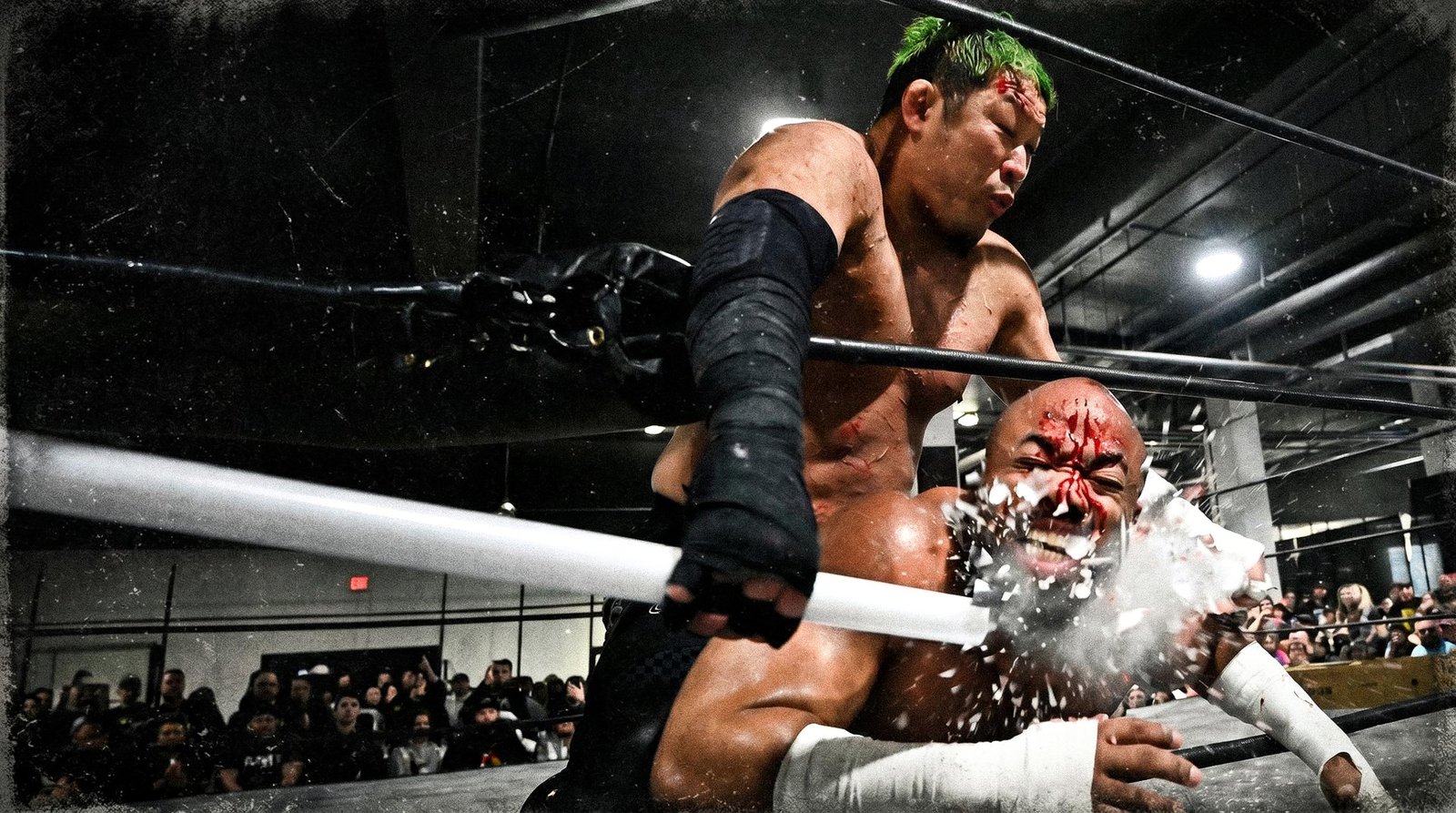
It’s safe to say the event went off without a hitch and delivered several memorable moments, including the insane first-round match between Lil’ Sicko and Nino Extremo. But when it was all said and done, one name stood above the rest in terms of impact.
Jonathan Gresham.
The Octopus Brings Violence
Yes, that Jonathan Gresham. The technical wrestling wizard, “The Octopus,” the foundation of pure wrestling, stepped into the world of ultraviolence and competed in his first-ever deathmatch tournament.
When his name was first announced, the reaction was shock. This is a former ROH Pure Champion, a wrestler defined by precision, discipline, and technical mastery, not barbed wire and broken glass.
At least, that’s what we thought.
Gresham entered the first round against deathmatch legend and Hall Of Famer, Masashi Takeda, known to many as “Crazy Kid.” And just like that, the idea became reality. There was no turning back.
But what Gresham accomplished that night went far beyond simply stepping into a new environment, he elevated it.

Deathmatch Psychology
For years, deathmatch wrestling has faced criticism from non-fans who dismiss it as mindless violence or a mockery of professional wrestling. To them, it’s nothing more than glass, blood, and chaos.
But professional wrestling is art—and deathmatch wrestling is simply one of its most extreme forms.
Jonathan Gresham understood that.
From the opening moments, he approached the match with intention. He didn’t abandon who he was, he adapted it. Small details told the story: clearing glass from the mat to minimize damage, choosing positioning carefully, and thinking like a wrestler trying to win, not just survive.
It may seem minor, but it’s everything.
In theory, a wrestler’s goal is to win while taking the least amount of damage possible. Deathmatches often abandon that logic in favor of spectacle. Gresham didn’t. He brought psychology into chaos.
But then, something changed.
As the match intensified, Gresham got lost in the moment. The ring filled with shattered light tubes and glass, and instinct took over. When Takeda hit the ropes, Gresham reacted without thinking, dropping down like he would in any traditional match.
Only this time, it wasn’t a canvas beneath him.
It was glass.
Unfamiliar Territory
The shards tore into his chest and stomach, and he sold it. Not just the pain, but the realization. It was a subtle, brilliant moment that encapsulated the entire story. A pure wrestler learning, in real time, what this world demands.
For the most part, the action stayed inside the ring, reinforcing the structure of a traditional match. Even when both men spilled to the outside to break a submission—since there are no rope breaks—they quickly returned. Nothing felt unnecessary. Nothing was wasted.
And as the match went on, so did Gresham’s confidence.
Bloodied and cut, he didn’t retreat, he adapted. That intensity built to one of the most unforgettable moments of the weekend. He hit a picture-perfect shooting star press onto Takeda, who was draped with light tubes.
It was as beautiful as it was brutal.
In the end, Takeda secured the victory, and eventually went on to win the entire tournament. But Gresham didn’t lose.
He earned something far more important… respect.
A Welcoming Community
Gresham proved that psychology belongs in deathmatch wrestling. He showed that it isn’t just about weapons and shock value, but about storytelling, intention, and purpose. The majority of the match revolved around a single weapon—light tubes—and yet it stood out as one of the best of the entire tournament.
And it wasn’t just fans who noticed.
GCW World Champion Atticus Cogar called the match “the blueprint,” praising its balance of professional wrestling and ultraviolence, its efficiency, and its storytelling.
He left a Facebook comment under a fans post to say;
“The match was a perfect example of what deathmatch wrestling can be when it’s approached with intention. if the genre wants to continue growing and if the performers want to create something sustainable and actually valuable, this match is the fucking blueprint.
the match was the perfect balance of professional wrestling and ultraviolence. they accomplished everything they needed to with just two bundles of tubes and a single box of light tubes. they never had to leave the ring. every bump mattered. every weapon had a purpose. nothing was wasted and nothing was done simply for shock value.
i would recommend this match to every deathmatch wrestler, every aspiring deathmatch wrestler and every fan who appreciates professional wrestling as an art form rather than bloodshed for the sake of bloodshed. it was a masterclass in storytelling.
it was perfect.”
Independent veteran B-Boy echoed that sentiment, calling it his match of the year and highlighting the seamless clash of styles and presentation on a Instagram story.
Even those closest to Gresham took notice—though perhaps not all with the same enthusiasm, as his wife, WWE star Jordynne Grace, who doesn’t want to see it again.
But admiration outweighed concern across the wrestling world. Because what Gresham did wasn’t just step into a deathmatch, he expanded it.
He didn’t conform to the style, he enhanced it. And in doing so, he reminded everyone that deathmatch wrestling is still wrestling, just painted on a far more violent canvas.
The Final Words, From Gresham
Gresham himself reflected on the experience in a blog post, writing:
“There’s a deathmatch wrestler living inside me. He’s been there for a long time. And after this weekend, I think he wants out… because he sees another canvas. Another language. Another way to tell stories through professional wrestling.”
That’s the key.
Another canvas.
Because that’s exactly what this was, a new medium for one of the most technically gifted wrestlers in the world to create something different, something raw, and something meaningful.
And if this was just the beginning, then the deathmatch world, and professional wrestling as a whole, should be paying very close attention.
Explore it, Gresham. Because the audience doesn’t just want more.
The art form needs it.