



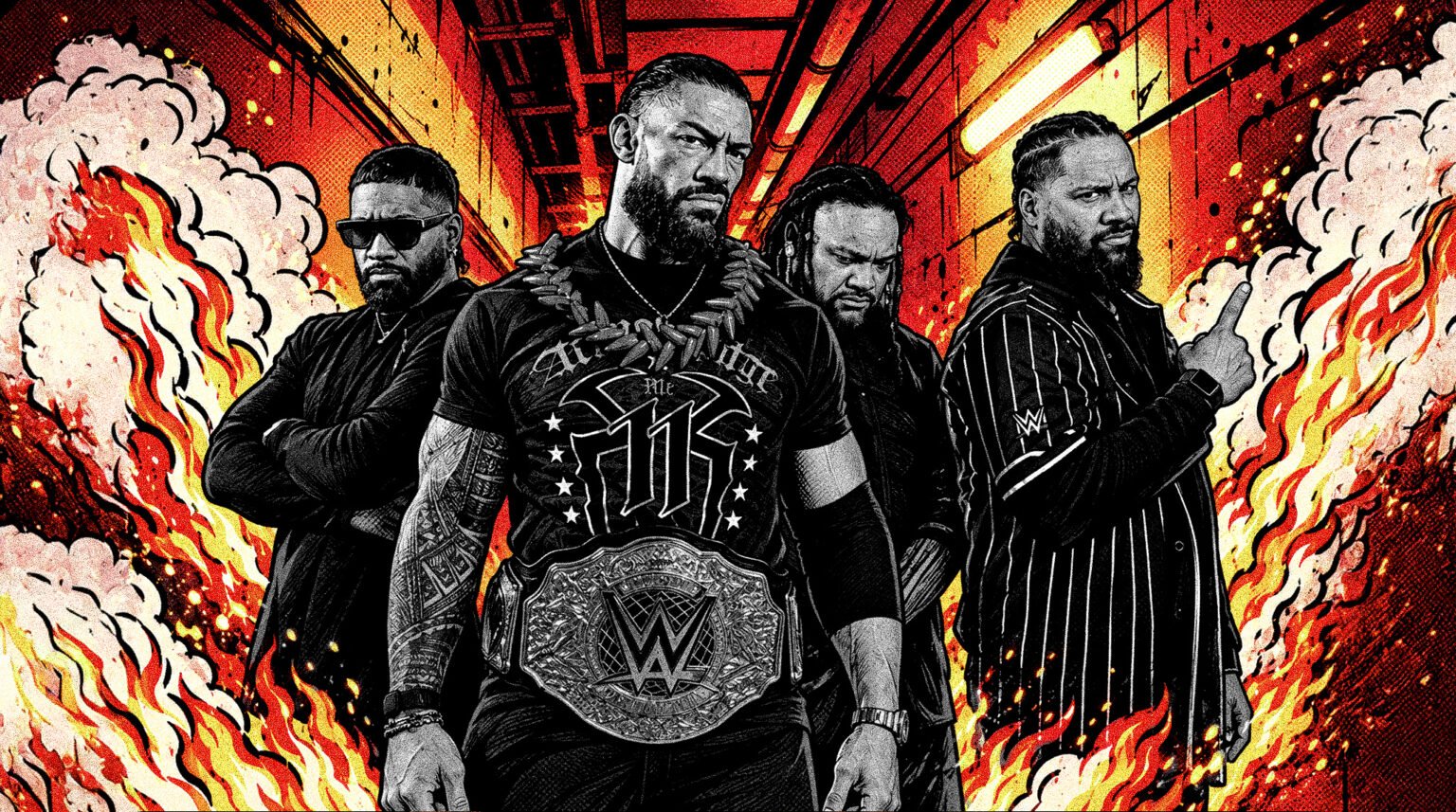

Roman Reigns may finally be learning to let go. The Bloodline may still be living by the rules he taught them.
That possibility makes the family’s latest reunion more complicated than another collection of potential betrayals. Roman has shown he can confront an old grievance without surrendering to it. His relatives have also built careers, alliances and ambitions that cannot simply be folded back into the roles they once occupied.
Past interviews offer clues to where those competing developments could lead. Paul Heyman has identified Apocalypse Now as an influence on the Tribal Chief. Jacob Fatu associated his discarded Caesar Sikoa name with Planet of the Apes.
Those connections carry different weight, but both invite a closer look at what happens when a powerful leader’s relationship with his people changes.
Roman Has Already Shown He Can Let Something Go
SummerSlam supplied an important piece of evidence.
During his match with Seth Rollins, Roman had the opportunity to use the weapon most closely associated with their original betrayal. Instead, he threw the chair away. He won with three successive Spears, then shared the Shield fist bump with the man whose actions had haunted him for years. The discarded chair was symbolic.
That’s important when making any prediction about The Bloodline. Roman demonstrated that he could revisit the source of an old wound and choose a different response. He also won without the family rescuing him.
It would be premature to treat that as proof that every controlling instinct has disappeared. Forgiving Seth and accepting independence from his relatives are different challenges. Roman still described Jacob as a soldier under the Usos’ orders on October 5.


The tension between those moments is worth following. Roman can make progress while still expecting to have the final word.
His next development may depend on what happens when someone refuses to give it to him.
The Burden Behind the Tribal Chief
In an interview with The Hollywood Reporter, Heyman explained that he had Roman study Apocalypse Now. Colonel Kurtz, the commander who establishes his own following beyond conventional military authority, informed the character’s initial presentation.
Heyman emphasized a contradiction. Kurtz builds a world in which everyone depends on him, then resents the weight of their expectations. Roman’s demand for acknowledgment creates a similar trap. His importance depends on being needed, but being needed becomes another grievance.
Roman might begin abandoning his old methods while the people around him continue using them.
The film offers more than the image of a powerful man brought down. Kurtz’s apparent acceptance of his approaching death is commonly interpreted as part of his recognition of the condition he has created. After killing him, Willard declines the opportunity to take his place.
Those are different choices by different characters. They do not establish a retirement plan for Roman. They do, however, suggest a richer wrestling conclusion than simply replacing one man at the head of the table.
Roman could be forced to confront the limits of his authority and eventually accept them. His challenger could reject the expectation that victory requires reproducing his rule.
The relevant ending would be the end of unquestioned command. Roman could remain part of the family, and part of WWE, without controlling everyone’s place within it.
The Family Learned His Methods
The difficulty is that Roman’s relatives have already absorbed some of his habits.
Solo was publicly anointed Tribal Prince in December 2023. He later took control during Roman’s absence, before losing their January 2025 Tribal Combat match.
His attempt to lead did not end the comparisons. After The MFTs lost the tag titles on March 20, 2026, Tama Tonga challenged the way Solo was addressing the group.
“You’re starting to sound like Roman,” Tama told him.
Three days later, LA Knight made the same comparison to Jey, who justified his actions through perceived disrespect toward the family.
The repetition suggests a problem that survives changes in allegiance. Solo sought his own authority. Jey found singles success beyond Roman. Both could still reach for Roman’s language when challenged.
That is what makes a late redemption potentially tragic. Roman might begin abandoning his old methods while the people around him continue using them.
He taught the family that respect could be demanded, disobedience punished and personal ambition presented as collective responsibility. Improving his own behavior would not automatically undo those lessons.
The Caesar Connection Has Two Sides
Jacob’s original proposed name initially suggests Julius Caesar. His own reference was more specific.
On No-Contest Wrestling, he recalled Caesar Sikoa and said, “I’m about to be like Caesar from Planet of the Apes.”
Unlike Heyman’s comments, that does not confirm a creative influence on the storyline. It establishes Jacob’s association with the name. The films still provide a useful comparison, particularly when the discussion extends beyond Caesar becoming a leader.
In Dawn of the Planet of the Apes, Caesar’s willingness to pursue coexistence clashes with Koba’s experience of human cruelty. Koba’s suffering gives him reasons to distrust Caesar’s judgment, but it does not make his eventual betrayal just.
That offers a way to understand how a leader’s changed intentions can fail to reach someone carrying different memories. Roman may believe he is offering reconciliation. Jacob may still remember being excluded from the prosperity that supposedly benefited the family.
His April confrontation with Roman made that grievance explicit. Jacob described struggling financially and credited Solo with reaching out. Roman responded by claiming he had approved Jacob’s opportunity.
They were telling different stories about the same relationship.
Jacob’s hardship does not guarantee that he would lead differently. His decisions would have to prove it.
War for the Planet of the Apes complicates the comparison further. Caesar himself becomes consumed by revenge and approaches the hatred he once opposed. Screenwriter Mark Bomback discussed how the film brings him toward Koba’s outlook before relationships help pull him back.
Applied to The Bloodline, the question becomes whether those who recognize Roman’s faults can avoid reproducing them. Jacob’s hardship does not guarantee that he would lead differently. His decisions would have to prove it.
A Shared Enemy Cannot Settle Every Grievance
Solo’s October 5 return alongside The Bloodline creates the immediate test. Their conflict with The 946 gives them a reason to cooperate. It does not settle what Solo and Jacob owe each other, or what either expects from Roman.
Jacob already turned against Solo at Money in the Bank 2025. He also already challenged Roman in Tribal Combat at Clash in Italy. Another declaration of rebellion would revisit ground he has covered.
A more consequential development would concern his right to participate in decisions that affect him.
Roman bringing Solo back could be a practical act of reconciliation. It could also expose the assumption that Roman decides when everyone else should move on. Jacob’s response will help distinguish between those readings.
The 946 make that pressure possible without needing to become Jacob’s future faction. After their attack on him, a reunion with Royce Keys would require its own reckoning. The central conflict can develop within the family’s existing relationships.
Who Forces the Change, and Who Accepts It?
Jacob is the strongest candidate to force the transition. His grievance began with what the family’s success had failed to provide him. His current position makes him useful to its leadership. The unresolved question is whether usefulness gives him an equal voice.
Jey could make that challenge decisive. Having fought Roman and succeeded independently, he has reasons to understand the demand for autonomy. He also has to confront the possibility that he has adopted parts of Roman’s behavior himself.
Solo complicates succession. He was once designated an heir and has already led his own group. A dispute started by Jacob could reopen Solo’s ambitions without making Solo the person the others trust. Jimmy’s choice would help determine whether the Usos respond together or pull the family in different directions.
The most convincing prediction is therefore a confrontation that ends with Roman accepting a limit on his authority. Jacob forces the issue, while the others establish that returning to the family does not mean surrendering the people they became outside his control.
That could culminate in defeat, a refusal of acknowledgment or a decision Roman cannot reverse. A graceful departure would have to be earned through that conflict. The meaningful act would be his choice not to retaliate.
The darker possibility is that he never gets the chance to make it. His family could remove him through the suspicion, manipulation and violence he helped normalize. A successor might even repeat his promises while rebuilding the same hierarchy.
Either outcome would make Roman’s recent growth central to the story. In one, he changes enough to preserve the family as his command ends. In the other, he changes too late to stop the damage from returning to him.
Roman has spent years demanding that his family acknowledge him. His final test may be whether he can acknowledge who they have become without him.