




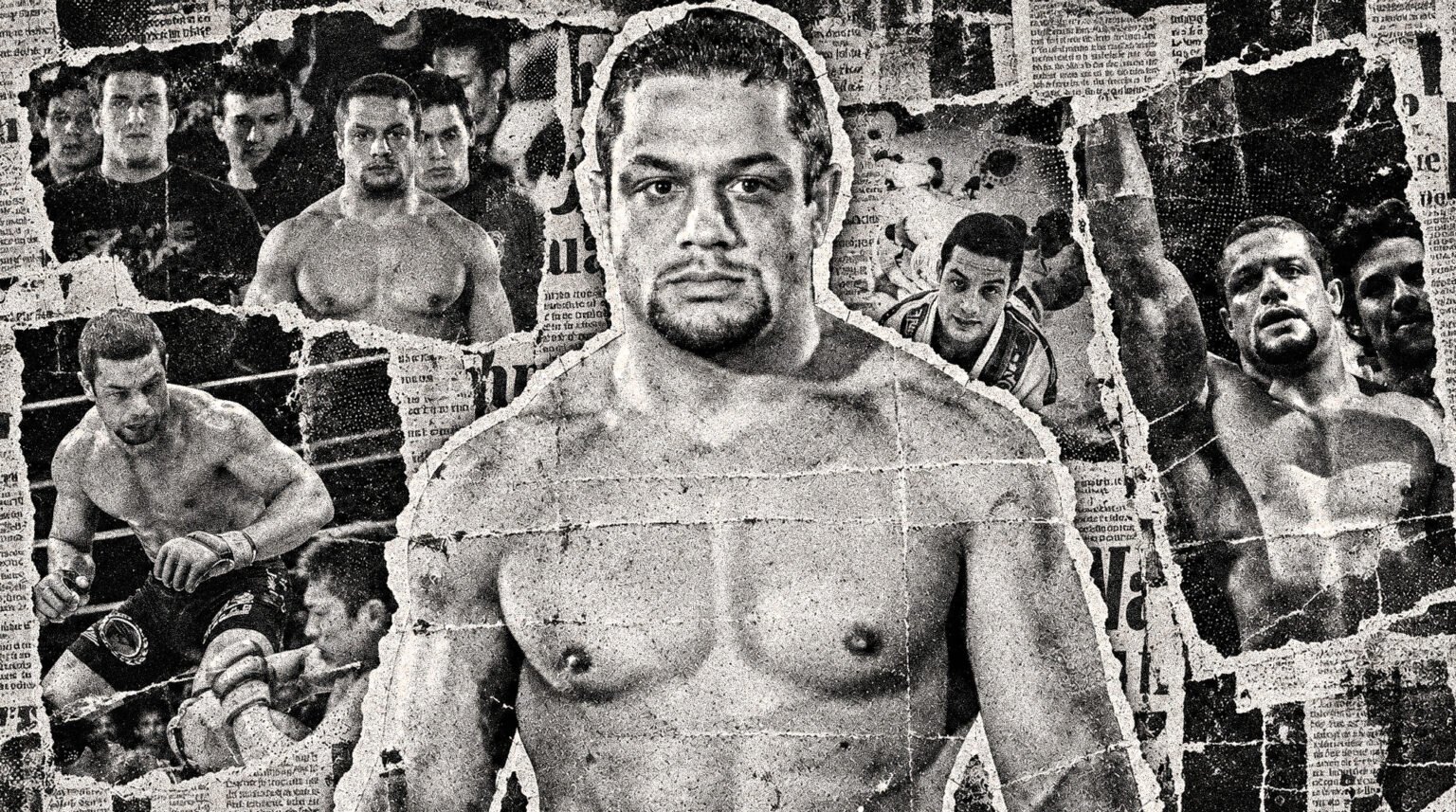

Ryan Gracie carried one of the most recognizable surnames in martial arts. His family helped bring Brazilian jiu-jitsu to the world, with Royce’s victories in the early UFC demonstrating what a smaller fighter could accomplish against larger opponents.
But Ryan’s reputation was built as much in nightclubs and street confrontations as it was on the mat. He became known as “Fera,” a nickname meaning beast, and his life gave people plenty of reasons to remember it.
A gifted fighter and influential teacher, Ryan could also be volatile, confrontational, and seemingly incapable of walking away from a feud. His story stretched from Rio de Janeiro’s notorious Pit Boy culture to Japan’s PRIDE ring, before ending in a São Paulo police cell at just 33.
Growing Up Gracie
Born in Rio de Janeiro in 1974, Ryan was the son of Robson Gracie and the younger brother of Renzo and Ralph. Fighting was part of the family environment long before he stepped into a professional ring.
According to BJJ Heroes’ account of his childhood, his parents separated when he was ten, and Renzo took on a paternal role within their Barra da Tijuca household. The brothers covered the living room with mats, turning their home into a place to train and, at times, settle disputes.
Ryan developed his jiu-jitsu at Gracie Barra and earned his black belt under Carlos Gracie Jr. Outside the academy, however, he became associated with a much rougher side of the sport.
BJJ Heroes describes him as a symbol of the Pit Boys, predominantly middle-class young men, often trained in jiu-jitsu, whose confrontations became a notorious feature of Rio’s nightlife during the 1990s and early 2000s. The term encompassed a broader culture of violent groups rather than a single academy or fighting team.
The family name opened doors. Ryan’s temper frequently put him on the other side of them.


An Academy and an Unfinished Feud
In 1995, Ryan and Ralph opened a jiu-jitsu academy in São Paulo. Ryan developed a successful team, with fighters including Gabriel Vella, Fabio Leopoldo, and Renato Migliaccio among the competitors associated with his coaching.
Running an academy did little to quiet his personal rivalries. The most infamous involved Wallid Ismail.
A Carlson Gracie black belt, Ismail had defeated Ralph, Renzo, and Royce in jiu-jitsu competition. Those victories gave him considerable bragging rights, and Ryan was hardly inclined to let the subject pass.
Accounts differ on how the feud began. Some say Ryan took issue with Wallid bragging about beating his relatives. Others point to Ryan’s private fight with a man known as Tico. Wallid reportedly cornered Tico, whose ear Ryan allegedly bit during the fight.
By 1999, the feud had become physical. In his retrospective for Sherdog, Brazilian journalist Marcelo Alonso reported that Ryan punched Wallid backstage at the World Jiu-Jitsu Championship. Public challenges and further confrontations followed.
A proposed fight under the World Extreme Fighting banner never materialized. Instead, their encounters continued outside sanctioned competition.
One of the most notorious occurred around a Bad Boy fashion event in 2000. In an account published by Full Contact Fighter and preserved in an online news archive, Wallid claimed Ryan approached him from behind and attempted to punch him. Wallid said he avoided the blow, caught Ryan in a guillotine when he attempted a takedown, and choked him unconscious.
A feud that could have sold a professional fight instead unfolded through backstage attacks, public insults, and competing stories. Despite repeated attempts to arrange a bout, Ryan and Wallid never settled it in the ring.
“I am almost like Billy the Kid. Everyone in the west wants to defeat Billy the Kid because he was the best.”
Ryan Gracie during an interview with Onzuka Martial Arts News in 2004
The Competitor Within
PRIDE gave Ryan a stage large enough to match his reputation.
He made his professional MMA debut against Tokimitsu Ishizawa on August 27, 2000, stopping him with punches in just 2:16. His next assignment was considerably tougher.
Kazushi Sakuraba had already defeated Royler, Royce, and Renzo Gracie. When Ryan faced him in December 2000, he became another member of the family unable to solve the Japanese star, losing by unanimous decision.
A July 2001 rematch with Ishizawa brought another setback when a rib injury ended Ryan’s night. He then won his remaining four professional fights, beginning with an armbar victory over Shungo Oyama.
His October 2003 meeting with Kazuhiro Hamanaka remains one of the clearest examples of his aggression inside the ring. Fighting on PRIDE’s first Bushido card, which featured a Japan-versus-Gracie team competition, Ryan finished Hamanaka with strikes and soccer kicks in the opening round. The finishing sequence captured the ferocity that made his appearances compelling.
A split-decision win over Ikuhisa Minowa followed. On December 31, 2004, Ryan submitted Yoji Anjo with an armbar in what became his final professional appearance.
All seven of his MMA bouts took place in PRIDE. He finished with five wins, two losses, and four victories inside the distance. His career was brief, but it supplied more than enough action to explain why fans remembered him.
Nightclub Violence and Run-Ins With Police
Wallid was far from Ryan’s only adversary.
In 2000, Ryan was accused of stabbing Marcus Vinicius da Rosa during a nightclub brawl in Rio de Janeiro. He spent 18 days in custody, and Folha reported that he was under investigation for attempted homicide.
Ryan disputed the accusation. In archived reporting from the time, he claimed that Rosa had brought the knife and was injured during their struggle after Ryan intervened to protect another man.
The same reporting included an allegation from Mauricio Lima, president of the Rio de Janeiro Jiu-Jitsu League. Lima said Ryan punched him after he criticized Robson Gracie’s prejudice toward gay people in a letter published by Tatame.
“I criticized his father, and Robson did not retaliate. I don’t get it,” Lima said in the archived English-language account. “At the night club, Ryan said I was bad-mouthing his dad and punched me in the chin. I didn’t fight back.”
Ryan denied punching Lima. The archive also attributed a response to him in which he mocked Lima and discussed comments made during his television program, Ring Heroes.
“I have nothing against gays,” Ryan was quoted as saying.
His remarks then took a contradictory turn:
“Personally, I think homosexualism is an ugly thing, two hairy men touching each other… ugh. Now, two women having sex is ok!”
The exchange brought another dimension to a confrontation already involving family loyalty, public insults, and an allegation of violence.
Further trouble followed in September 2005, when Folha reported that Ryan was accused of assaulting a civil police officer and insulting a police chief inside a São Paulo police station.
His Final Arrest
On December 14, 2007, Ryan was arrested in São Paulo after a sequence involving a stolen car and attempts to take other vehicles.
According to contemporary reporting, he threatened a motorcycle rider, who resisted. Other riders helped restrain Ryan until police arrived. He was taken into custody and eventually placed alone in a cell at the 91st Police District.
Psychiatrist Sabino Ferreira de Farias Neto attended to him. The doctor said a urine test indicated cocaine, marijuana, and Frontal, an anti-anxiety medication. He also said Ryan admitted using cocaine.
Ryan was agitated and confused. During the hours before his death, the psychiatrist administered several additional medications.
At approximately 8 a.m. on December 15, Ryan was found dead in his cell. He was 33.
The Cocktail of Drugs and the Court Case
The combination of substances became central to the investigation.
In a December 17 report, Folha listed the medications the psychiatrist said he administered: Dienpax, Topamax, Capoten, Leponex, Fenergan, and Haldol. The treatment included both tablets and injections. The doctor denied that the medication caused Ryan’s death.
Ryan’s father, Robson, and sister, Flávia, blamed the psychiatrist, alleging that he had given Ryan excessive medication.
Reporting on the forensic findings in February 2008 described the combined effects of the administered medication and the drugs Ryan had already consumed. According to the police investigator quoted by Folha, the combination depressed his central nervous system and led to cardiorespiratory arrest.
The criminal case continued for years. The psychiatrist was initially convicted, but São Paulo’s Court of Justice acquitted him on appeal in September 2016.
UOL reported that the appellate judges accepted an explanation involving Ryan’s drug use and a congenital heart condition. The defense argued that the medications had been administered in therapeutic doses.
For the family, the ruling closed neither the loss nor the years of anger surrounding his death.
The Family He Left Behind
Ryan’s son, Rayron, had turned six shortly before his father died.
Speaking to MMA Fighting in 2017, he recalled the difficulty of growing up without him, from making Father’s Day gifts for other relatives to watching classmates leave school with their dads.
His own memories of Ryan centered on their home in São Paulo, where they played together in a ring in the living room. Ryan’s students remained close, becoming part of the extended family that supported him.
“Even though he’s gone and we still miss him, for sure, he left this family and this team for me.”
Those were Rayron’s words, describing what his father had left behind beyond the headlines.
The legacy of “Fera” extends much farther than his achievements in the ring. To his son, he was a father whose absence never stopped hurting. To the team that remained close to Rayron, his influence continued long after his final fight.
He was, and always will be, jiu-jitsu’s bad boy.
The streets ultimately proved to be his toughest fight.