


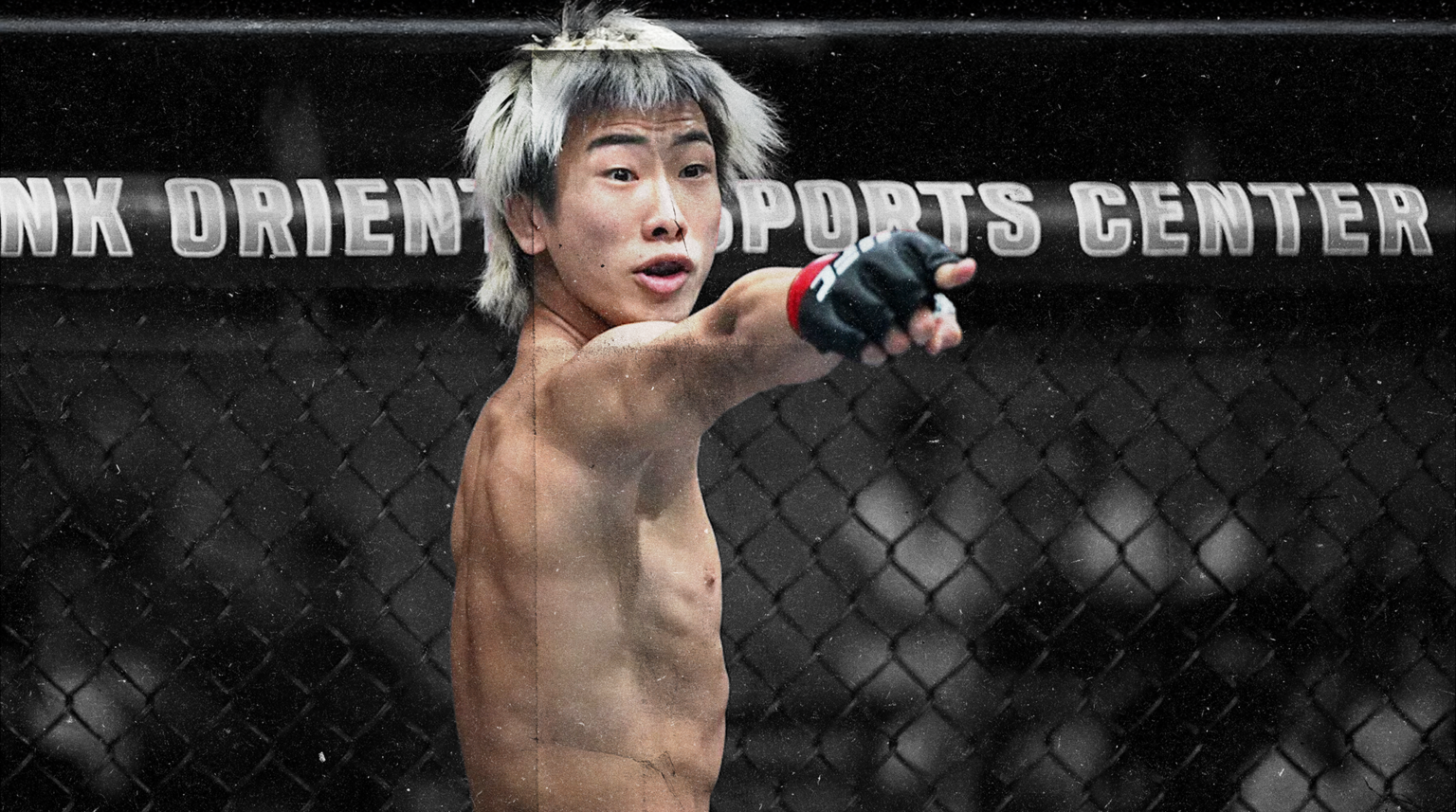

Rei Tsuruya was already a champion before the UFC became part of his professional résumé. At 20, he had captured the Pancrase flyweight title, finished each of his first six opponents, and established a style built around making opponents defend before they could settle into a fight.
The appeal went beyond an unbeaten record. Tsuruya attacked with the urgency of someone who saw every scramble as another opportunity to finish. His wrestling created openings for ground strikes, while the reactions to those strikes exposed submissions.
That combination carried him from Japan’s regional circuit through Road to UFC and into the Octagon. Along the way, tougher opposition tested the assumptions that followed his early success.
His career offers a closer look at what happens when a gifted young grappler reaches opponents who can interrupt his preferred way of fighting.
A Young King of Pancrase
Tsuruya began his professional MMA career in 2021, competing in DEEP before moving to Pancrase. By December 2022, he was challenging Satoru Enomoto, who competed under the name Sarutobi, for the promotion’s flyweight championship.
At Pancrase 330, Tsuruya submitted Enomoto with a second-round rear-naked choke. The victory brought his record to 6–0, with three knockouts and three submissions. Less than two years into his professional career, he had a championship to accompany the attention surrounding him.
His development also had a foundation beyond those six fights. His father, Hiroshi Tsuruya, was a Shooto veteran, and Rei brought competitive wrestling experience to MMA. In a 2024 UFC interview, he credited winning the Pancrase title with giving him confidence that he could compete against the world’s best.
The championship mattered because it gave his potential something measurable. He had progressed from finishing opponents in preliminary appearances to defeating an established titleholder in a scheduled five-round fight.


Making Opponents React
The original attraction of Tsuruya’s game was how quickly he could turn pressure into grappling opportunities.
Against Kenta Kubo at DEEP 104, his punches forced a defensive reaction before he changed the angle and completed a takedown. His striking occupied Kubo long enough to create an opening for his wrestling.
Once on top, Tsuruya used ground strikes to force further reactions, then pursued the positions they exposed. An opponent turning away from punches could surrender his back, allowing Tsuruya to switch from inflicting damage to hunting a submission.
His willingness to keep attacking made those exchanges compelling. Against stronger opposition, the challenge would be sustaining that pressure when opponents defended his initial entry, escaped from underneath him, or forced him to repeatedly regain position.
The Route to the UFC
Tsuruya reached the UFC through its Road to UFC tournament, building on his domestic success without the RIZIN stop once envisioned for him.
He submitted Ronal Siahaan in the opening round of the Season 2 flyweight bracket, then defeated Mark Climaco by unanimous decision in the semifinal. In February 2024, he stopped Jiniushiyue with strikes at 4:59 of the first round to win the tournament.
Those results added something his early résumé had lacked. The Climaco fight required him to win across three rounds. The final showed that his finishing ability remained central to his game.
At UFC 303, he followed with a unanimous decision victory over Carlos Hernandez. Shinsuke Nakamura’s presence in his corner added crossover attention, but the performance supplied the substance. Tsuruya had taken another step beyond domestic promise and won against an opponent with UFC experience.
The decisions did not diminish his appeal. They broadened the evidence available to judge him. Finishing opponents had brought him attention; winning when a finish did not materialize was another part of becoming a dependable competitor.
What the Joshua Van Fight Revealed
Joshua Van handed Tsuruya his first professional defeat at UFC 313 in March 2025, winning by unanimous decision.
The matchup exposed a difficulty that an unbeaten record could not answer. Van defended 17 of Tsuruya’s 21 takedown attempts, using his defensive wrestling and scrambles to limit the time spent trapped in grappling exchanges.
Tsuruya could still create moments on the ground, but he could not consistently keep the fight there. Van’s ability to return to striking exchanges forced him to keep rebuilding his offense.
For a fighter whose strongest work begins with getting hold of an opponent, that is an expensive problem. Repeated entries demand energy, and unsuccessful attempts give the opponent more opportunities to establish a rhythm on the feet.
The developmental question became more specific. Tsuruya needed ways to make his preferred attacks harder to anticipate and more productive when they succeeded. Better striking setups, more efficient entries, and stronger control after a takedown all serve that purpose.
The defeat placed limits around the early hype without erasing the skills behind it.
Beyond the Unbeaten Record
Tsuruya’s subsequent performances reinforced why his grappling had attracted attention in the first place. He submitted Luis Gurule with a first-round rear-naked choke in May 2026, then finished Kevin Borjas with the same submission that August.
Those victories demonstrated that his finishing ability remained a threat against UFC opposition. They did not, by themselves, settle every question raised by the Van fight. Opponents who can repeatedly deny his grappling still present a different challenge.
That distinction makes his development worth following. Tsuruya has an identifiable strength capable of deciding fights, along with clear areas that influence how consistently he can apply it.
Winning the Pancrase championship at 20 established the promise. Winning beyond Japan showed that the promise could travel. His progress now depends on how effectively he can impose that same game when opponents know what is coming and have the tools to resist it.