


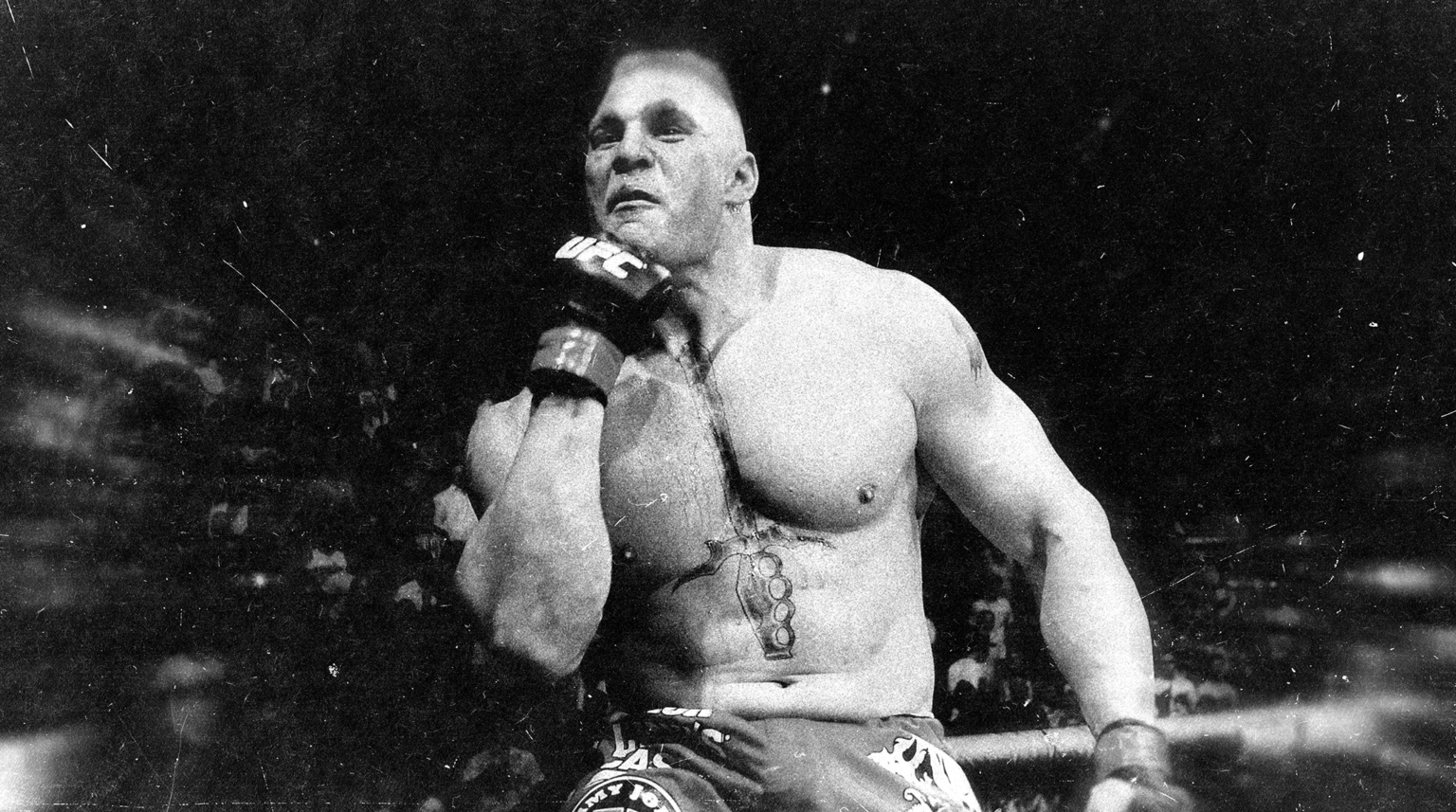

Brock Lesnar brought the UFC an audience that already knew his name and a question that could sell a fight before he had established himself in the sport.
- A Familiar Name With a Wrestling Foundation
- A Defeat That Kept the Question Alive
- From Crossover Attraction to Heavyweight Champion
- UFC 100 and the Power of a Rematch
- A Comeback With Something New to Prove
- The Limits of a Short Reign
- A Return That Showed the Name Still Mattered
- A Bigger Audience for the Heavyweights
- Explore the Building the UFC Series
Could the former WWE champion do it in the Octagon?
His size and reputation made the experiment compelling. His wrestling background gave it credibility. When he became heavyweight champion, the UFC gained something more valuable than a famous visitor. It had a crossover attraction whose fights carried consequences at the top of a division.
Lesnar’s run was short, but its commercial impact was substantial. He helped make heavyweight championship fights major events for audiences whose interest extended beyond MMA, placing himself at the center of some of the promotion’s biggest nights.
A Familiar Name With a Wrestling Foundation
By the time Lesnar entered MMA, professional wrestling had already made him recognizable. WWE audiences knew the imposing physique, explosive movement, and presence that made him stand out even among other heavyweight performers.
Beneath that presentation was a genuine competitive foundation. Lesnar won the NCAA Division I heavyweight wrestling championship for the University of Minnesota in 2000. His transition to MMA required new skills, but he arrived with experience controlling opponents who were actively trying to stop him. There was a plausible competitive question beneath the spectacle.
His athleticism and wrestling suggested he could succeed. His limited MMA experience left obvious uncertainties about submissions, striking, and how he would respond when an opponent could exploit those gaps.
For the UFC, those competing possibilities were part of the appeal. Supporters wanted to see his physical gifts translate. Skeptics wanted to know whether an established fighter would expose him.


Both had a reason to watch.
A Defeat That Kept the Question Alive
Lesnar entered his UFC debut against Frank Mir at UFC 81 in February 2008 with just one professional MMA victory. The promotion immediately matched him with a former heavyweight champion rather than slowly introducing him through inexperienced opposition.
Lesnar’s early offense showed why his transition had attracted attention. His strength and wrestling created immediate danger, but Mir caught him in a kneebar and submitted him in the first round.
The result exposed the difference between having transferable skills and possessing a complete MMA game. It also gave the audience a more interesting story than an easy debut victory would have provided.
Lesnar could hurt a proven heavyweight. He could also make a mistake that ended the fight.
He returned against Heath Herring at UFC 87 and won a unanimous decision. The performance demonstrated that he could control an experienced opponent over three rounds, providing a competitive basis for the attention surrounding him.
His name had accelerated his opportunity. Now his results were beginning to support it.
From Crossover Attraction to Heavyweight Champion
Lesnar challenged Randy Couture at UFC 91 in November 2008, just his fourth professional MMA fight.
The matchup brought together two very different kinds of recognition. Couture was one of the UFC’s most respected champions, with years of evidence behind his reputation. Lesnar was the physically imposing newcomer whose ceiling remained uncertain.
His rapid title opportunity invited debate, but that debate strengthened the interest. Could experience and tactical intelligence overcome the challenger’s size, athleticism, and wrestling?
Lesnar stopped Couture in the second round to win the heavyweight championship. Less than a year after losing his UFC debut, he held one of the promotion’s most prominent titles.
The victory changed the nature of his appeal. Fans following him from wrestling were now watching a UFC champion. Established MMA viewers had to assess him as a serious part of the division’s title picture.
The UFC could promote both the familiar celebrity and the competitive stakes. Each made the other more valuable.
UFC 100 and the Power of a Rematch
The rematch with Mir at UFC 100 in July 2009 brought Lesnar’s rise back to the opponent who had interrupted it.
Mir held the interim heavyweight championship, giving their second meeting a title-unification purpose. But had Lesnar developed enough to beat the fighter who had exposed his inexperience?
This time, Lesnar controlled Mir on the ground and stopped him with punches in the second round.
The performance gave his championship reign greater credibility. He had beaten Couture, then avenged his UFC debut defeat against another established heavyweight.
UFC 100 reportedly generated approximately 1.6 million pay-per-view buys, setting a promotional record at the time.
Lesnar was not the event’s only attraction. Georges St-Pierre defended his welterweight championship. Dan Henderson faced Michael Bisping following their coaching rivalry on The Ultimate Fighter. The milestone branding and strength of the card mattered, too.
But Lesnar’s rematch occupied the headline position and supplied a central attraction that reached across audiences.
His contribution was giving people who might not follow the UFC regularly a recognizable reason to purchase one of its biggest events. Once they arrived, the rest of the card had an opportunity to earn their attention.
A Comeback With Something New to Prove
A serious bout of diverticulitis interrupted Lesnar’s reign in 2009. His return against interim champion Shane Carwin at UFC 116 in July 2010 would test both his recovery and his ability to remain champion.
Could he return from illness and withstand another heavyweight’s power?
Carwin nearly ended the fight in the opening round, forcing Lesnar to survive sustained punishment. In the second, Lesnar secured a takedown and finished an arm-triangle choke to retain the championship.
The victory added a different quality to his story. His earlier success had emphasized imposing himself on opponents. Against Carwin, he had to endure a dangerous stretch before finding a way to win.
For viewers who questioned how he would respond when his physical advantages were not enough, the fight supplied an answer.
The event reportedly exceeded one million pay-per-view purchases, showing that Lesnar could deliver blockbuster numbers without UFC 100’s milestone billing.
His run had produced several kinds of attraction in a short period. There was the unfamiliar challenge of his arrival, the ascent to a title, the revenge fight, and the comeback from illness. His performances kept giving the UFC another chapter to promote.
The Limits of a Short Reign
Lesnar lost the championship to Cain Velasquez at UFC 121 in October 2010. Another bout of diverticulitis later forced him out of a scheduled meeting with Junior dos Santos and required surgery.
He returned against Alistair Overeem at UFC 141 in December 2011, lost by first-round stoppage, and announced his retirement from MMA afterward.
Illness substantially disrupted his career, and the defeats demonstrated that his physical tools did not solve every matchup. His championship reign included two successful defenses, but it did not develop into the sustained dominance associated with the sport’s longest-serving champions.
Lesnar’s importance rests on the combination of competitive achievement and commercial impact within a relatively small number of appearances.
He gave the heavyweight division a champion people already recognized, then placed that recognition behind fights with established contenders and champions.
A Return That Showed the Name Still Mattered
After returning to WWE, Lesnar came back to the Octagon against Mark Hunt at UFC 200 in July 2016. His presence gave another milestone card a crossover attraction years after his initial run had ended.
He initially won by unanimous decision, but that result did not stand. Following positive tests for clomiphene and its metabolite, Lesnar received a doping suspension, and the Nevada State Athletic Commission overturned the victory to a no contest.
His return nevertheless showed how much promotional interest remained attached to his name. The UFC could still build anticipation around his participation even after years away from MMA.
That lasting recognition helps explain why his impact was larger than the length of his championship reign.
A Bigger Audience for the Heavyweights
Lesnar offered the UFC an unusual combination. He arrived with an established audience, possessed the athletic background to compete seriously, and achieved enough inside the cage to keep his appearances relevant beyond curiosity.
His heavyweight title wins gave the crossover substance. His rivalries and setbacks gave audiences stories to follow. The business surrounding his biggest cards demonstrated how valuable that combination could become.
The UFC already had champions capable of producing compelling fights. Lesnar helped put those events in front of people who knew him from somewhere else.
Brock Lesnar made the move from wrestling attraction to UFC heavyweight champion, then helped turn that achievement into blockbuster business. His run showed how much an established star could expand the promotion’s audience when he could also win at its highest level.
Explore the Building the UFC Series
From proving what worked inside the Octagon to bringing millions of new fans to the sport, these eight fighters helped shape the UFC at pivotal points in its history. Explore their stories:
- Royce Gracie
- Ken Shamrock
- Randy Couture
- Tito Ortiz
- Matt Hughes
- Chuck Liddell
- Forrest Griffin
- Georges St-Pierre
- Anderson Silva
- B.J. Penn
- Brock Lesnar
- Ronda Rousey
- Conor McGregor