




Pro wrestling biopics have plenty to work with beyond championship victories and backstage rivalries. Behind the characters are people navigating family expectations, personal ambition, and the demands of an industry that can make their identities difficult to separate from their jobs.
When we first published this list, the Von Erich family and Ric Flair were among our selections. Hollywood has since taken notice. The Iron Claw brought the Von Erichs’ story to theaters in 2023. Dwayne Johnson’s Seven Bucks Productions announced a Flair biopic in 2024.
Their stories illustrate how much ground wrestling offers filmmakers. A compelling adaptation can make these stories resonate with people who have never watched a wrestling match.
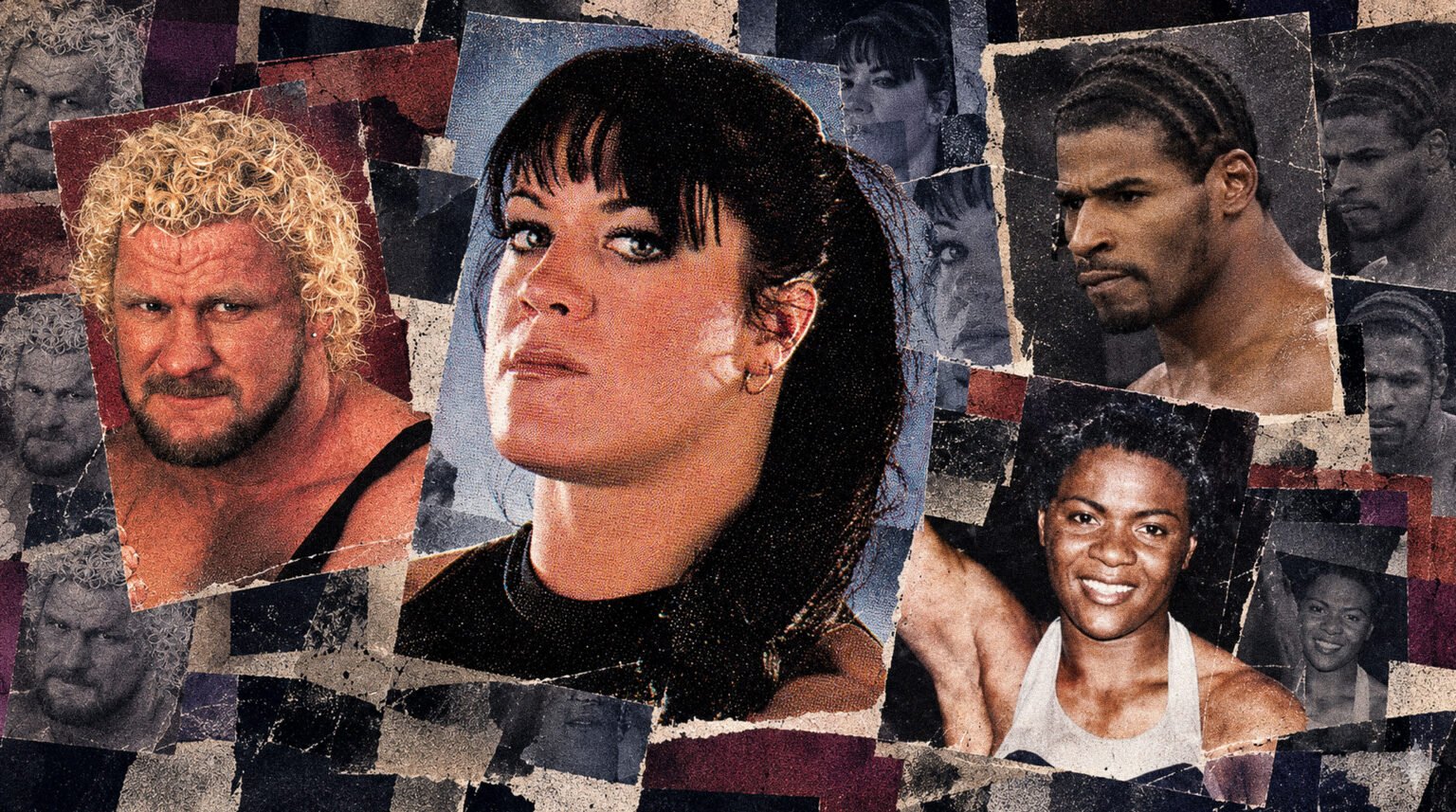
These six wrestlers’ lives offer very different stories for filmmakers to explore.
Eddie Guerrero
Eddie Guerrero’s charisma would be essential to any movie about his life. His mischievous smile, comic timing, and ability to make an audience feel involved in his schemes were as important to his appeal as his wrestling.
That warmth could give a film about his struggles and recovery its emotional foundation. Guerrero’s journey offers room to explore the expectations of a wrestling family, the damage caused by addiction, and the work involved in rebuilding both a career and the trust of loved ones.
His victory over Brock Lesnar at No Way Out 2004 provides a natural destination. Winning the WWE Championship was a defining professional achievement, but a film could establish why reaching that moment meant more than finally receiving top billing.
Chavo Guerrero has discussed interest in adapting the Guerrero family’s story, so the possibility has already attracted attention. An Eddie-focused film could center on a gifted performer trying to reclaim his life and make the most of another opportunity.



A film should give as much attention to the joy, humor, and determination that defined Guerrero’s life as it does to his tragic death. His wrestling style also deserves emphasis, showing why other performers continue to borrow his moves, mannerisms, and signature spots.
Ethel Johnson
Ethel Johnson’s story would introduce many viewers to a chapter of wrestling history they have never encountered.
One of the first Black women in professional wrestling, Johnson belonged to a pioneering generation that included her sisters Babs Wingo and Marva Scott. Their careers unfolded amid the racism and sexism facing Black women competing in the 1950s and beyond. The documentary Lady Wrestler: The Amazing, Untold Story of African-American Women in the Ring helped preserve those experiences.
A dramatized adaptation could build around the sisters’ relationship and the unusual working life they shared. Training, traveling, and establishing themselves as performers would give the film opportunities to explore ambition alongside the practical realities of pursuing it.
Johnson’s athletic ability should be central to that portrayal. Audiences need to see what made her worth watching and understand why she pursued wrestling, alongside the barriers she encountered.
That combination could make for a compelling sports drama that gives audiences a chance to know Johnson beyond her place in wrestling history.
David Schultz
David Schultz’s life offers a sharp change of direction for a filmmaker. He went from being a feared professional wrestler to working as a professional bounty hunter.
Wrestling provides the background, and his second career opens the story to unfamiliar situations and relationships.
His 1984 assault on ABC reporter John Stossel remains the incident most closely associated with his name. After Stossel questioned wrestling’s legitimacy, Schultz struck him during an interview. His later move into bounty hunting supplies a substantial second chapter beyond that notorious confrontation.
A movie could use the transition to examine the intimidating identity Schultz cultivated and how it functioned outside wrestling. A reputation that helped sell tickets takes on different implications when someone’s work involves pursuing fugitives.
There is room here for a rough-edged character study with the momentum of a crime drama. Wrestling provides the background, and his second career opens the story to unfamiliar situations and relationships.
The adaptation would need to scrutinize Schultz’s account of his life rather than simply reproduce his toughest stories. The appeal is in understanding the man behind that reputation, including the choices that made it difficult to escape.
Hardbody Harrison
Before his criminal case, Harrison Norris Jr. appeared in WCW under the name Hardbody Harrison. He never became one of the promotion’s major stars, but his experience in a nationally televised wrestling company gave him a background he could use to attract aspiring wrestlers.
Norris used promises of professional wrestling training to lure women into a sex-trafficking operation. That connection makes his story particularly disturbing: an opportunity to enter the business became a means of exploitation.
According to evidence presented at his trial, Norris controlled women through violence, isolation, and debts he continually increased. He charged them for necessities and imposed fines for breaking his rules, then told them they could not leave until they paid what he claimed they owed. Several had been promised training for his women’s wrestling company.
A federal jury convicted Norris in 2007 of crimes including sex trafficking, forced labor, and witness tampering. He initially received a life sentence, but after an appeal and resentencing, he received 35 years. That sentence was upheld in 2011.
The case offers the foundation for a crime drama following the women he exploited, the investigation, and their testimony against him. Wrestling would be central to understanding how he presented himself and made his promises appear credible.
The strongest adaptation would build its tension around how that control operated and how the women helped expose it. Their experiences and testimony could give the film its perspective, with Norris’s wrestling background explaining the access he exploited.
Chyna
Chyna’s presence challenged the roles women were usually given in mainstream American wrestling. She competed against men and became the first woman to hold the Intercontinental Championship, creating an image of female strength that stood apart from the division around her.
That rise deserves substantial attention in a film about Joanie Laurer. Building the physique, confidence, and performance behind Chyna would give an actor more to explore than a collection of familiar television moments.
The central relationship could be between Laurer and the identity that made her famous. Being presented as extraordinary helped make her a star, but a film could also explore her desire for acceptance and the difficulty of finding a place beyond that character.
Documentaries, including Vice Versa: Chyna, have already examined her life and its painful later chapters. A dramatized adaptation should give equal care to her ambition, personality, and accomplishments.
The strongest version would allow audiences to spend time with Joanie as a person and see someone building a career, forming relationships, and imagining a future. Her achievements deserve to feel as vivid as the losses.
Bray Wyatt
Bray Wyatt could make an entire arena feel like part of his world. When the lights went down and his Fireflies raised their phones, his entrance became something fans helped create. That connection belongs at the heart of any film about Windham Rotunda.
Wyatt was one of one, and the sight of those Fireflies lighting an arena helps explain why his loss felt so personal.
Wyatt was an enigma whose appeal extended beyond his matches. Fans searched his promos for hidden meanings, debated clues, and tried to anticipate where his imagination would take them next. From the Wyatt Family to the Firefly Fun House and The Fiend, he gave them reasons to keep looking closer.
His creative genius was in making those strange, unsettling ideas feel like something people could belong to. A film could explore how Rotunda built that relationship while revealing the person behind the characters his audience worked so hard to understand.
His interaction with The Undertaker at Raw’s 30th anniversary in January 2023 felt like a passing of the torch, an endorsement of Wyatt as wrestling’s new face of fear. He had already created something unmistakably his own, but that acknowledgment made the moment special.
The documentary Bray Wyatt: Becoming Immortal has explored his life and career. A dramatized adaptation could bring his imagination to the screen through the imagery he created, grounded in his relationships with family, collaborators, and the fans who embraced him.
His death in 2023 left the painful sense that there was still so much he had to give. It may feel too soon to dramatize his life, but someday, a film could celebrate the imagination and connection that made him irreplaceable. Wyatt was one of one, and the sight of those Fireflies lighting an arena helps explain why his loss felt so personal.