


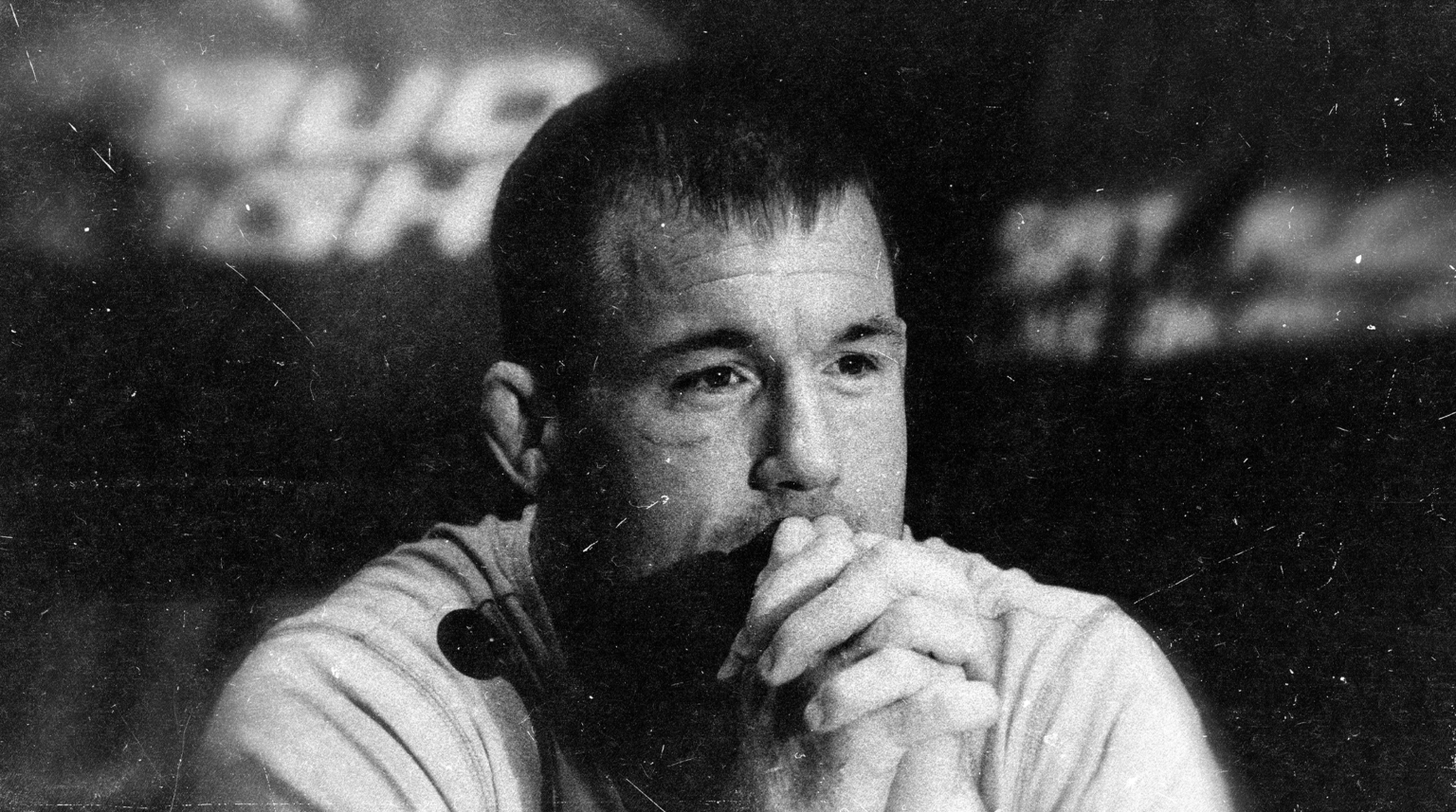

Matt Hughes helped make the UFC’s welterweight championship a prize audiences understood through the difficulty of taking it from him.
- A Champion Built on More Than Strength
- A Division With Stories to Follow
- Four Minutes That Showed What the UFC Could Deliver
- A Champion Fans Could Get to Know
- The Fight Between the UFC’s Past and Present
- The Standard a New Generation Had to Surpass
- A Lasting Place in the UFC’s Growth
- Explore the Building the UFC Series
His strength was immediately apparent. He could lift opponents, carry them across the Octagon, and put them down in positions from which escaping became its own exhausting contest. Beneath that physical force was a fighter capable of recognizing openings, surviving trouble, and finishing with submissions.
Across two championship reigns, Hughes completed seven successful title defenses. His opponents included established contenders, future stars, and fighters whose victories over him would become defining achievements of their own.
That gave the UFC something valuable as its audience grew. Hughes was an established champion with a history viewers could follow. Beating him meant something, and watching someone try could be an attraction in itself.
A Champion Built on More Than Strength
Hughes brought an accomplished wrestling background into MMA. A two-time NCAA Division I All-American at Eastern Illinois University, he developed his fighting skills within Pat Miletich’s team, a camp closely connected to the UFC’s early welterweight history.
That environment helped turn his wrestling into a complete competitive approach. Takedowns created opportunities for strikes, positional control, and submissions. Opponents had to account for what followed the initial burst of strength.
His first UFC championship came against Carlos Newton at UFC 34 in November 2001. Caught in a triangle choke, Hughes lifted Newton before the fight ended with a dramatic slam and Hughes awarded the knockout victory.
The unusual finish invited questions. His subsequent championship run supplied a more sustained demonstration of his ability.

Hughes defended against Hayato Sakurai, Newton in a rematch, Gil Castillo, Sean Sherk, and Frank Trigg. Different opponents brought different problems, but the championship stayed with him.
For fans following the division, that consistency established a clear reference point. A promising contender’s credentials mattered, but the ultimate question was whether those skills would hold up against Hughes.
A Division With Stories to Follow
B.J. Penn disrupted that certainty at UFC 46 in January 2004. Moving up from lightweight, he submitted Hughes in the first round to take the welterweight championship.
The result demonstrated how much significance Hughes’s reign had acquired. Penn had beaten the fighter who had repeatedly turned away the division’s challengers.
After Penn’s departure from the UFC and the stripping of his title, Hughes received another championship opportunity. At UFC 50 in October 2004, he faced a young Georges St-Pierre for the vacant belt. Hughes submitted him with an armbar with one second remaining in the opening round.
Both encounters became foundations for longer rivalries. Penn had shown that Hughes could be beaten. St-Pierre had discovered how difficult that task could be.
The division now offered more than a succession of unfamiliar challengers. Audiences could follow unfinished business, improvement, and the possibility of revenge. Hughes stood at the center of those stories.
Four Minutes That Showed What the UFC Could Deliver
His rematch with Frank Trigg at UFC 52 in April 2005 became one of his most memorable performances.
An uncalled low blow left Hughes vulnerable, and Trigg followed with an attack that brought him close to losing the championship. Trigg took his back and threatened a rear-naked choke.
Hughes escaped, lifted the challenger, and carried him across the Octagon before slamming him down. Moments later, he secured a rear-naked choke of his own. The reversal took place within a fight that lasted just four minutes and five seconds.
The timing gave the performance additional importance. UFC 52 followed the first season of The Ultimate Fighter, with coaches Chuck Liddell and Randy Couture headlining the event. Hughes and Trigg gave that card another fight capable of rewarding a new viewer’s attention.
Its appeal required little technical explanation. The champion was in trouble, survived, and immediately turned the fight around. Strength, composure, and submission skill all became visible within the same sequence.
The bout later entered the UFC Hall of Fame’s Fight Wing. It remains a clear example of how Hughes could make grappling dramatic for audiences still learning the sport.
A Champion Fans Could Get to Know
Hughes joined the second season of The Ultimate Fighter as a coach in 2005. The role brought him into the UFC’s expanding television presence, giving viewers time with a champion they might previously have known mainly through fight results.
His confidence and demanding manner could generate different reactions. Some viewers could appreciate the certainty of an established champion. Others could find him abrasive and want to see that confidence challenged.
Either response gave his next fight a personal dimension.
That became especially apparent when Hughes coached opposite Matt Serra in season six. Their disagreements supplied a rivalry that remained compelling even after neither man held the championship. When they finally fought at UFC 98 in May 2009, Hughes won a closely contested unanimous decision.
The UFC could build interest around his relationships with other fighters as well as his place in the rankings. His reputation gave those conflicts context, while television gave audiences more opportunities to choose a side.
The Fight Between the UFC’s Past and Present
At UFC 60 in May 2006, Hughes faced Royce Gracie in a non-title main event.
The matchup offered a direct comparison between the fighter who had defined the earliest UFC tournaments and the reigning welterweight champion. Gracie’s return supplied nostalgia and curiosity. Hughes supplied a demanding test of how the sport had developed.
Hughes controlled the grappling exchanges and finished Gracie with strikes at 4:39 of the first round.
The performance showed why reducing him to a powerful wrestler missed part of his ability. He understood submission threats, advanced his position, and combined grappling with effective offense. The skills Gracie had once used to expose unprepared opponents had become part of the education of elite fighters.
The event reportedly generated approximately 620,000 pay-per-view purchases. That business belonged to the matchup, with Gracie’s return central to its appeal, but Hughes’s standing made the comparison credible. The UFC had a contemporary champion it could put opposite a foundational figure in a major attraction.
The Standard a New Generation Had to Surpass
Hughes avenged his first defeat to Penn at UFC 63 in September 2006, stopping him in the third round. It became the final successful defense of his second championship reign.
Two months later, St-Pierre defeated him at UFC 65 to take the title. Their third meeting, for the interim championship at UFC 79 in December 2007, ended with St-Pierre submitting Hughes.
The progression gave audiences a clear picture of a changing division. The challenger Hughes had submitted in 2004 had developed into a fighter capable of defeating him decisively.
Those losses did not make Hughes merely a stepping stone in someone else’s career. His own accomplishments gave the transition its weight. St-Pierre was overcoming an established standard, one built through years of championship performances.
Hughes had helped give welterweight a history that the next generation could inherit and challenge.
A Lasting Place in the UFC’s Growth
Hughes entered the UFC Hall of Fame in 2010 and formally announced his retirement in 2013. His championship résumé was already secure, but his contribution went beyond counting belts and defenses.
He gave the promotion a recognizable champion before its television breakthrough, delivered memorable performances as new viewers arrived, and participated in rivalries that kept the division interesting through changes at the top.
Fans could follow Hughes for his dominance, his recoveries under pressure, or the prospect of seeing a rival finally beat him. Those different reasons to watch helped sustain interest across his championship and post-championship years.
Matt Hughes made welterweight success something audiences could measure against a familiar, formidable opponent. He helped build the UFC by making his division’s title matter, then giving fans years of reasons to care who held it.
Explore the Building the UFC Series
From proving what worked inside the Octagon to bringing millions of new fans to the sport, these fighters helped shape the UFC at pivotal points in its history. Explore their stories:
- Royce Gracie
- Ken Shamrock
- Randy Couture
- Tito Ortiz
- Matt Hughes
- Chuck Liddell
- Georges St-Pierre
- Ronda Rousey
- Conor McGregor